

BRICS: From Questions Over India’s Place to India Hosting the World’s Emerging Powers — How the BJP Era Changed New Delhi’s Position
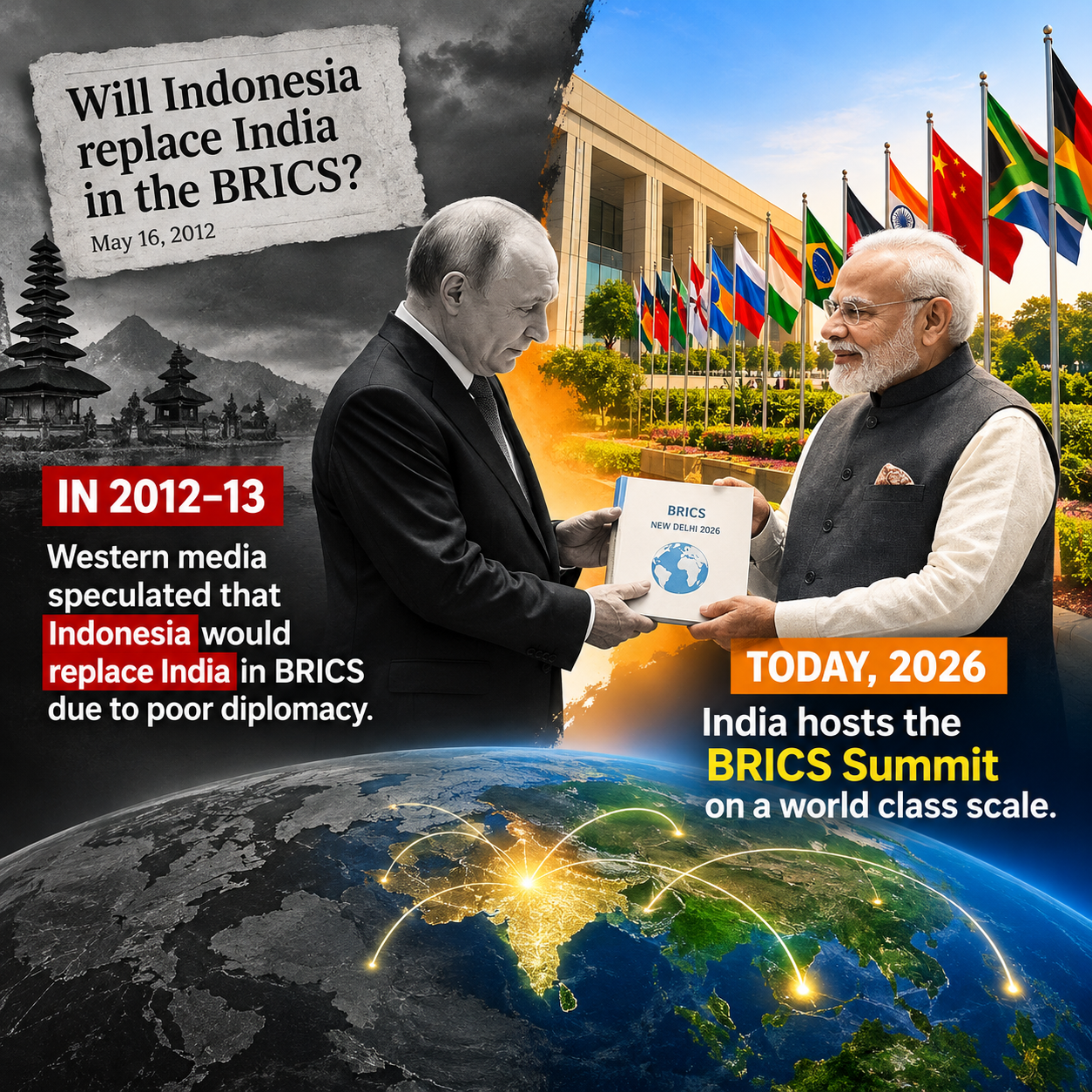
New Delhi, September 13, 2026: Fourteen years ago, India’s position in BRICS was facing serious questions. In 2012, amid slowing growth, high inflation, a weakening rupee and concerns over India’s sovereign credit outlook, analysts even speculated that Indonesia could replace India as the “I” in BRIC.
Fast-forward to 2026, and the picture is dramatically different: India is hosting the 18th BRICS Summit in New Delhi, with leaders of major emerging economies gathering in the Indian capital as New Delhi leads the grouping for the fourth time.
For the BJP, this contrast has become a powerful political argument: India has moved from being discussed as the weak link in BRICS to becoming one of its most influential members and the country setting the agenda.
From “Should India Remain?” to “India Leads”
The contrast between 2012 and 2026 is striking.
During the 2012 BRICS period, India was facing a difficult economic environment. Growth in 2012-13 fell below 5%, inflation was in double digits and concerns were raised about the country’s sovereign credit rating. The debate over whether Indonesia could replace India in the grouping reflected the uncertainty surrounding India’s economic trajectory at the time.
Today, India is in a substantially stronger position.
The 2026 BRICS summit is being held in New Delhi with 11 member countries, representing about 49.5% of the world’s population, 40% of global GDP and 26% of global trade.
India is not merely attending the meeting. It is chairing it.
The official Indian BRICS framework for 2026 is built around resilience, innovation, cooperation and sustainability, with India holding its fourth BRICS chairship after 2012, 2016 and 2021.
The BJP’s Political Argument
The BJP has directly contrasted the India of the UPA era with the India of the Modi era.
Senior BJP leader Ravi Shankar Prasad argued that while India’s position was being questioned during the 2011-12 period, the situation has changed dramatically, with BRICS leaders now gathering in New Delhi. He described India as a “bright spot” within BRICS and credited the Modi government with rebuilding and strengthening the country’s position.
The political message is straightforward:
2012 — India was being questioned.
2026 — India is setting the table.
That transformation is being presented by the BJP as evidence of India’s economic recovery, stronger diplomatic outreach and increased geopolitical weight.
Modi Government’s BRICS Moment
India’s increased influence is not limited to hosting the summit.
Under India’s 2026 chairship, more than 350 meetings and high-level engagements have been conducted across more than 25 Indian cities. New Delhi has also pushed practical cooperation in areas including trade, investment, technology, health, energy, food security and supply chains.
The 2026 summit declaration also focused on practical economic cooperation, including greater use of local currencies for trade and investment, cross-border payment systems, New Development Bank financing and new investment mechanisms. India also pushed initiatives involving digital public infrastructure, artificial intelligence, healthcare training and industrial competencies.
This represents a significant shift from merely being a participant in an international grouping to attempting to shape its agenda.
One Important Correction to the Viral Graphic
The image circulating with the claim that Indonesia would “replace India” captures a real 2012 debate, but it should be understood carefully.
Indonesia did not replace India in BRICS.
Instead, Indonesia joined BRICS in 2025, while India remained a founding member. BRICS has subsequently expanded to 11 members.
So the more accurate takeaway from the graphic is not that India permanently defeated an attempt to remove it, but that India survived a period when its economic position was being questioned and has since become a central player in an expanded BRICS.
Congress vs BJP: Two Different Narratives
The BRICS summit has also produced a political clash inside India.
Congress leader P. Chidambaram questioned whether India had received tangible benefits from recent BRICS summits and asked what India gains from international groupings.
At the same time, Congress MP Shashi Tharoor took a much more positive position on India’s hosting of BRICS, describing it as a matter of prestige and evidence of India’s diplomatic convening power.
The BJP has seized on this contrast to argue that the opposition is struggling to acknowledge India’s changing international position.
From Economic Doubt to Global Convening Power
The transformation should not be reduced to a single government or a single summit. India’s economic rise has deeper roots, and BRICS itself has evolved significantly since 2012.
But the political contrast is difficult to miss.
In 2012, reports were questioning whether India could retain its place at the heart of the BRICS grouping. In 2026, New Delhi is hosting Vladimir Putin, Xi Jinping and other leaders of the expanded BRICS grouping, while India is using its chairship to push its priorities for the Global South.
The BJP’s argument, therefore, is that the India that once faced questions about its economic credibility has become an India capable of convening some of the world’s most powerful emerging economies.
The BRICS journey in one line:
2012: “Could Indonesia replace India?”
2026: “India hosts the BRICS world.”
That is the political and diplomatic contrast the Modi government is highlighting as the 18th BRICS Summit concludes in New Delhi.