

New Delhi: A series of controversial statements associated with the Congress party has come under intense criticism from nationalist sections, who accuse the party of making statements that amplify narratives promoted by Pakistan and undermine India’s national interest.
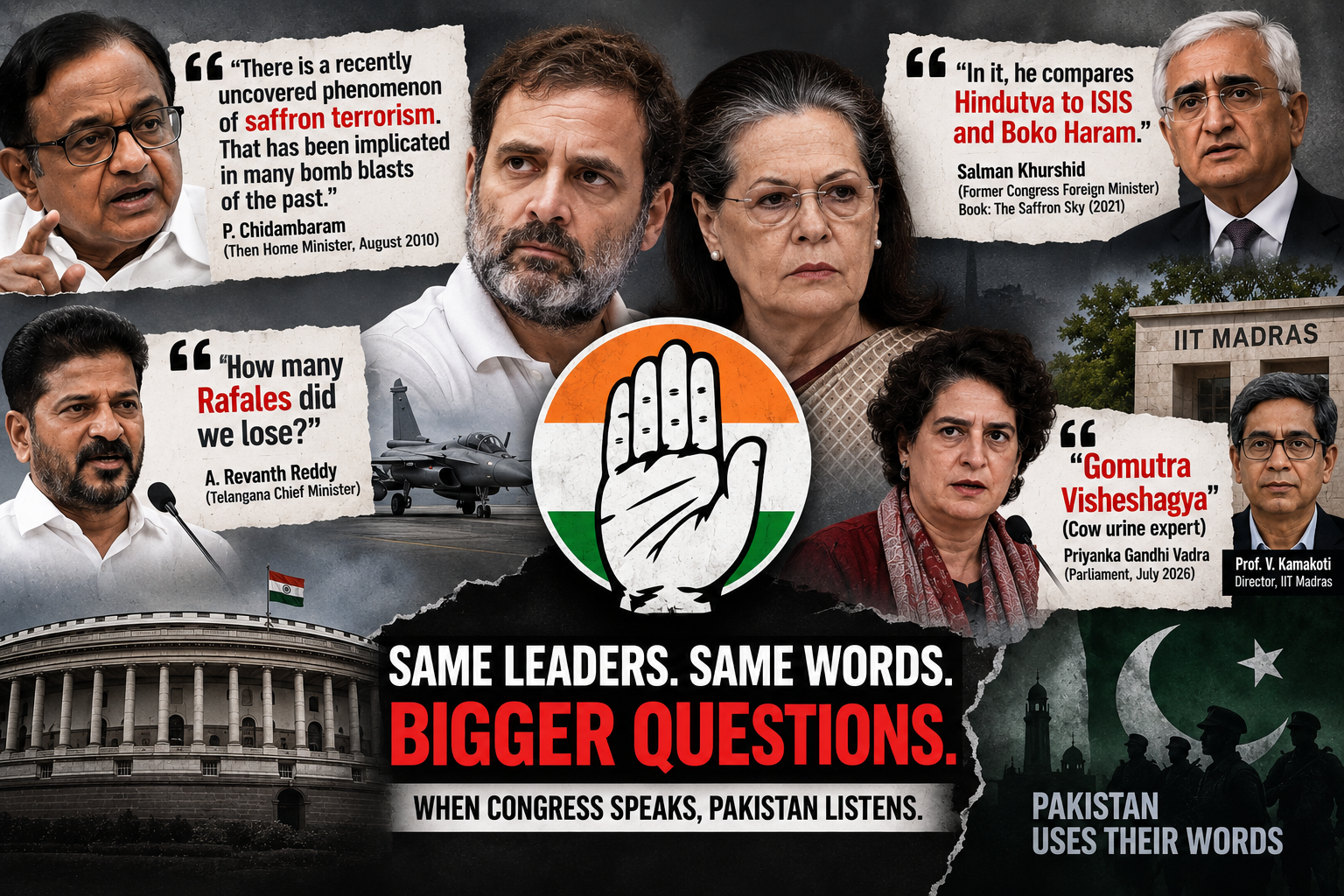
The controversy revolves around the use of the phrase “saffron terrorism,” comparisons involving Hindutva and ISIS and Boko Haram, Congress leaders’ questioning of India’s Rafale losses during Operation Sindoor, and the controversial “gaumutra visheshagya” remark directed at IIT Madras Director V. Kamakoti.
For nationalist critics, these are not isolated political controversies. They represent a disturbing pattern in which statements made by Indian political leaders can subsequently become useful material for India’s adversaries.
The question they are asking is direct:
When Congress’s political messaging overlaps with narratives promoted by Pakistan, where does political opposition end and the enemy’s narrative begin?
‘Saffron Terrorism’: A Phrase That Became a Political Flashpoint
In August 2010, then Congress Home Minister P. Chidambaram used the expression “saffron terrorism” while addressing senior police officials.
He said:
“There is a recently uncovered phenomenon of saffron terrorism. That has been implicated in many bomb blasts of the past.”
The expression immediately became politically controversial.
For nationalist critics, the use of the word “saffron” in connection with terrorism was particularly offensive because saffron has deep cultural and religious significance in Hinduism.
The criticism goes further. According to the allegations raised by nationalist commentators, the terminology subsequently became part of Pakistan’s narrative, with an Islamabad-based think tank citing Chidambaram while discussing “saffron terrorism.”
The nationalist argument is that Congress effectively created terminology that could later be used by Pakistan to portray Hindu identity negatively.
Congress did not merely lose a political argument, critics say—it supplied language that its adversary could use.
Allegations Against the RSS
The criticism also points to statements made two years later concerning the RSS.
Congress leaders were accused of alleging that the RSS was involved in running terror training camps.
For nationalist critics, such allegations represented an escalation of the political rhetoric surrounding Hindu nationalist organisations.
They argue that political parties can criticize their opponents, but accusations involving terrorism and national security carry consequences that extend far beyond ordinary electoral politics.
Hindutva Compared With ISIS and Boko Haram
The controversy resurfaced in 2021 when former Congress foreign minister Salman Khurshid published Sunrise Over Ayodhya: Nationhood in Our Times.
A chapter titled “The Saffron Sky” compared a form of Hindutva with extremist organisations including ISIS and Boko Haram.
The comparison provoked a major political controversy.
Senior Congress leader Ghulam Nabi Azad criticized the comparison, describing it as factually wrong and an exaggeration.
For nationalist critics, this was an especially serious episode.
They argue that there is a fundamental difference between criticizing a political ideology and comparing Hindutva with internationally recognized terrorist organisations.
The critics further point to the alleged subsequent use of such arguments in Pakistan’s political and diplomatic narratives.
Their accusation is that Congress rhetoric can provide material that India’s adversaries can exploit against the country.
Operation Sindoor and Pakistan’s False Rafale Claim
The criticism intensified during Operation Sindoor, India’s military operation launched on May 7, 2025. The Government of India officially uses the name “Operation Sindoor.”
During the conflict, Pakistan claimed that it had shot down three Indian Rafale fighter aircraft.
The claim became part of Pakistan’s information narrative surrounding the military confrontation.
The nationalist criticism focuses on what happened next.
Telangana Chief Minister and Congress leader A. Revanth Reddy publicly questioned how many Rafale aircraft India had lost. His remarks triggered a political controversy, with BJP leaders accusing Congress of echoing Pakistan’s narrative.
For nationalist critics, the timing was crucial.
The Rafale-loss figure was a Pakistani claim, and critics say it should have been treated as an adversary’s unverified—and ultimately false—claim rather than amplified in Indian political discourse.
Their criticism is blunt:
When Pakistan makes a false claim about India’s military losses, why should Indian political leaders repeat the claim instead of challenging it?
For nationalist critics, this episode represents another example of Congress allegedly amplifying a narrative originating from India’s adversary.
The ‘Gaumutra Visheshagya’ Controversy
Another controversy highlighted by critics concerns a remark made in Parliament in July 2026.
Congress MP Priyanka Gandhi Vadra referred to an individual as “gaumutra visheshagya,” or “cow urine expert,” during a Lok Sabha discussion.
The remark was understood to refer to IIT Madras Director V. Kamakoti.
The criticism centres on the contrast between the insult and the academic credentials of the person being targeted.
V. Kamakoti is associated with IIT Madras and has expertise in areas including computer architecture, cybersecurity and hardware design. He has also worked on India’s indigenous processor development.
Nationalist critics argue that reducing an Indian scientist and academic to a political insult involving a Hindu cultural reference demonstrates what they regard as anti-Hindu and anti-national rhetoric.
For them, the episode further reinforces their perception that Congress has increasingly adopted language that disrespects Hindu cultural symbols.
A Pattern, Not Isolated Incidents
Nationalist critics argue that the controversies should not be viewed separately.
They point to a sequence:
“Saffron terrorism.”
Comparisons between Hindutva and ISIS and Boko Haram.
Questions surrounding Pakistan’s false Rafale claim during Operation Sindoor.
Political ridicule involving the term “gaumutra visheshagya.”
According to critics, these incidents collectively raise questions about the political direction of Congress and the consequences of its rhetoric.
Their argument is that an opposition party has every right to criticize the government, but a national political party also has a responsibility to ensure that its statements do not strengthen the narrative of an adversary.
Whose Narrative Is Congress Amplifying?
This is ultimately the central question being raised by nationalist critics.
They argue that Pakistan has repeatedly attempted to use India’s internal political disagreements to strengthen its own international narrative.
When statements from Indian political leaders subsequently appear in Pakistan’s messaging, critics believe the circumstances deserve serious public scrutiny.
The issue, therefore, is not simply what Congress says.
It is whose narrative Congress chooses to amplify.
Critics argue that when political rhetoric originating in India becomes useful material for Pakistan, Indian political leaders should ask themselves whether they are helping their own political cause—or inadvertently helping an adversary.
Anti-National Allegations Against Congress
For sections of nationalist opinion, the cumulative effect has resulted in increasingly strong accusations that Congress is becoming an anti-national political party.
They argue that the term is justified, in their view, by what they consider a repeated willingness to use rhetoric that can be exploited by Pakistan, criticize Hindu identity through controversial terminology and question India’s military narrative during sensitive periods.
These critics say that Congress cannot simultaneously claim to represent the interests of Indians while ignoring the consequences of statements that India’s adversaries may exploit.
Their message is clear:
Political opposition is legitimate. But national interest must come first.
The Question Congress Must Answer
India has many political parties and fierce political disagreements are an unavoidable part of democracy.
But nationalists argue that there must be a boundary when India’s security, armed forces and national identity are involved.
Their question to Congress is therefore straightforward:
When Pakistan promotes a false narrative about India, should an Indian political party challenge it—or amplify it?
For nationalist critics, the answer is unequivocal.
They believe Congress’s record of controversial statements shows a pattern that deserves greater public scrutiny and that the party must be held accountable for the narratives it helps amplify.
The debate is no longer simply about Congress versus the BJP.
It is about a much larger principle:
When political interest conflicts with national interest, which one comes first?
For those raising these concerns, the answer is India first.
And that is why sections of nationalist opinion are increasingly describing Congress’s controversial statements as anti-national and questioning whether the party has placed political opposition above the national interest.